Santa's reindeer names: all nine, in order

Santa has nine reindeer in most tellings today: Dasher, Dancer, Prancer, Vixen, Comet, Cupid, Donner, Blitzen and Rudolph. The first eight come from the 1823 poem "A Visit from St. Nicholas," in that order. Rudolph joined in 1939, in a story written for a department store. Meet all nine below, then find out which one you are.

What do Santa's reindeer names mean?

Dasher, Dancer and Prancer are named for the way they move. Vixen means a female fox, Comet takes its name from the long-tailed comets of the night sky, and Cupid is the Roman god of love. Donner and Blitzen mean thunder and lightning. Here they are in the order the 1823 poem calls them, which is still the usual order today, with Rudolph as number nine:

  1. Dasher
  2. Dancer
  3. Prancer
  4. Vixen
  5. Comet
  6. Cupid
  7. Donner
  8. Blitzen
  9. Rudolph

In Clement Clarke Moore's 1844 book of poems, the roll call ends with "On, Comet! on, Cupid! on, Donder and Blitzen!" Today the seventh name is usually spelled Donner. Rudolph comes ninth because he arrived last, 116 years after the poem, though in most pictures he flies out in front.

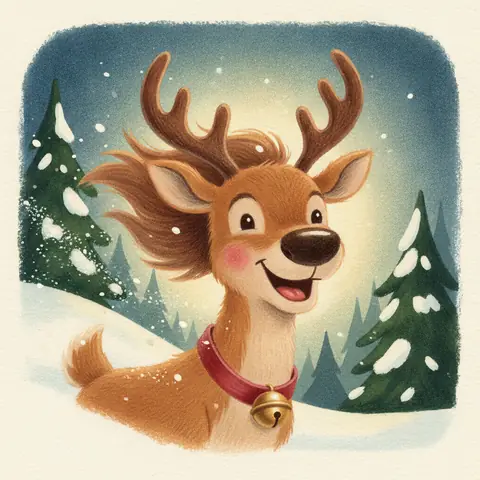
  1. Dasher, a grinning reindeer with a windswept mane, running through the snow past pine trees

    1. Dasher

    Name meansTo dash is to rush. Dasher is the one in a hurry.

    Stable loreFirst out of the stable every Christmas Eve, usually before the sleigh is packed.

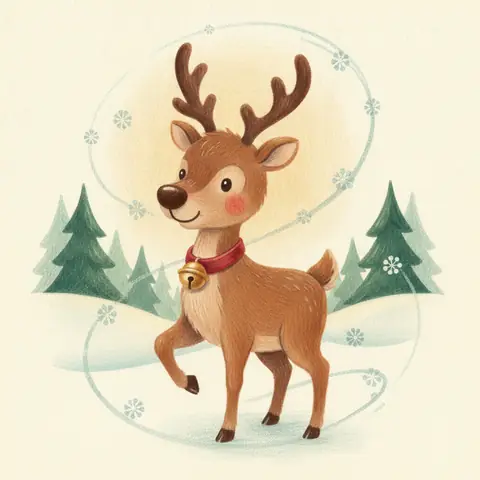
  2. Dancer, a young reindeer stepping lightly on one hoof in a swirl of snowflakes

    2. Dancer

    Name meansOne who dances.

    Stable loreLands on icy rooftops like they're dance floors and hums carols the whole way.

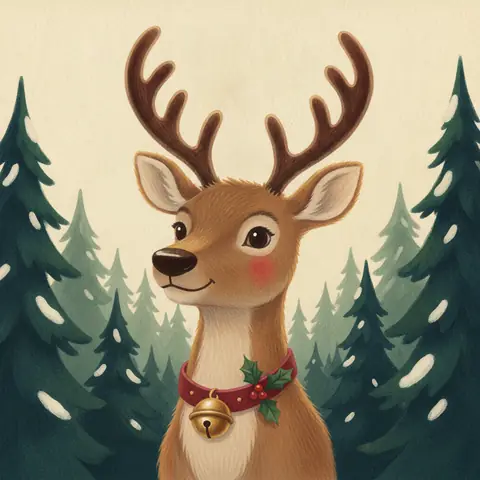
  3. Prancer, a proud reindeer with tall antlers and a holly-trimmed collar in a pine forest

    3. Prancer

    Name meansTo prance is to step high and springy, like a proud show horse.

    Stable lorePolishes the sleigh bells twice and walks into every room like it's a parade.

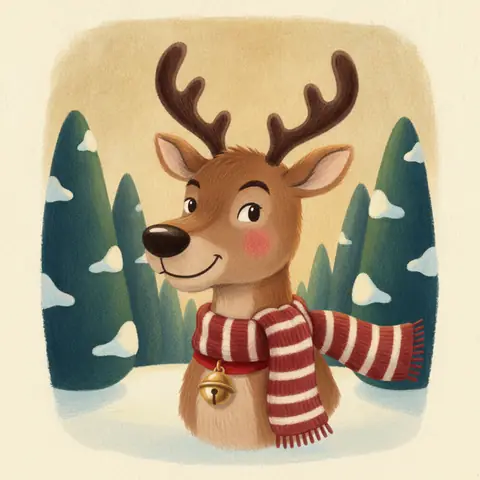
  4. Vixen, a sly, smiling reindeer wearing a red and white striped scarf

    4. Vixen

    Name meansA vixen is a female fox.

    Stable loreThe clever one. Knows every shortcut between rooftops and every hiding spot for cookies.

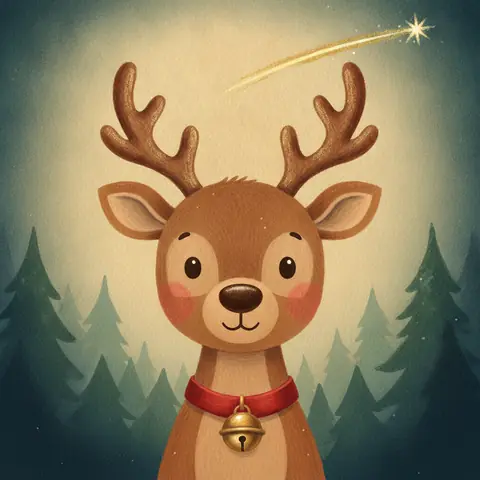
  5. Comet, a wide-eyed reindeer gazing up as a shooting star streaks across the sky

    5. Comet

    Name meansFrom the Greek for a "long-haired" star, after a comet's glowing tail.

    Stable loreThe navigator. Steers by the stars and makes a wish on every shooting star.

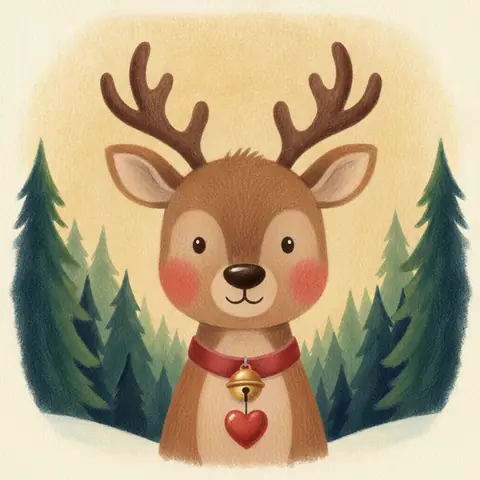
  6. Cupid, a rosy-cheeked reindeer with a little red heart hanging from its collar

    6. Cupid

    Name meansCupid is the Roman god of love. The name comes from the Latin for desire.

    Stable loreThe heart of the team. Shares carrots and never leaves anyone out.

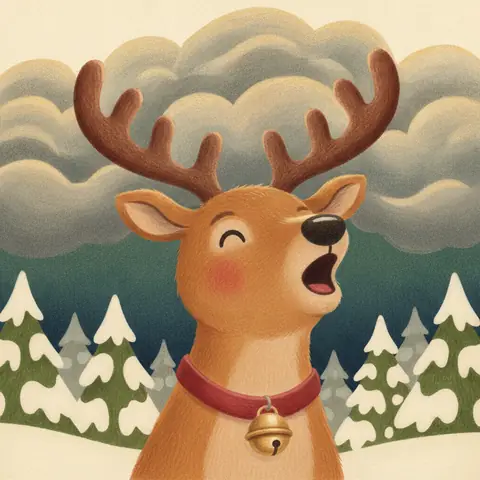
  7. Donner, a reindeer singing loudly with its eyes shut under rolling gray clouds

    7. Donner

    Name meansThunder. Donner is German; the poem's Dunder and Donder come from the Dutch donder.

    Stable loreBiggest laugh in the stable. Sings the low notes in the reindeer choir.

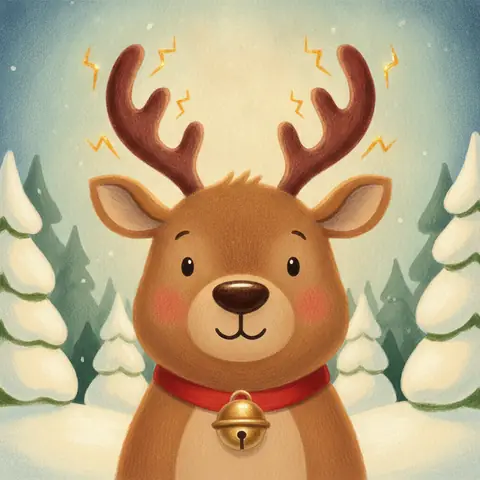
  8. Blitzen, a cheerful reindeer with tiny lightning bolts flashing around its antlers

    8. Blitzen

    Name meansLightning. Blitz is German for lightning; the 1823 Blixem echoes the Dutch bliksem.

    Stable loreQuick as a flash and a little bit fizzy, like the air before a storm.

  9. 9. Rudolph

    Name meansFrom old Germanic words for "fame" and "wolf." Robert L. May picked it in 1939 for his red-nosed reindeer.

    Stable loreNo portrait here: the stable artist says his nose glows too bright to paint. In the story, it lights Santa's way when the weather is too bad to see.

Which of Santa's reindeer are you?

Five quick questions. Your answers point to one of the eight reindeer from the poem. Then add your name, get your own reindeer name and save your card.

Reindeer stable quiz
Question 1 of 5It's Christmas Eve in the stable. What are you up to?
Question 2 of 5Pick a snack for the long flight.
Question 3 of 5A snowstorm rolls in. What's your move?
Question 4 of 5Where would you hang out at the North Pole?
Question 5 of 5Pick a superpower.

How many reindeer does Santa have?

Santa has nine reindeer if you count Rudolph, and most people do. The 1823 poem "A Visit from St. Nicholas" names eight: Dasher, Dancer, Prancer, Vixen, Comet, Cupid, Dunder and Blixem. Those last two later became Donder and Blitzen, and today usually Donner and Blitzen. The poem's team is small, too. It describes "a miniature sleigh, and eight tiny reindeer."

Robert L. May added Rudolph in 1939, and a hit song in 1949 made him famous enough to join the team for good. He is usually shown as the ninth and youngest reindeer, leading the sleigh.

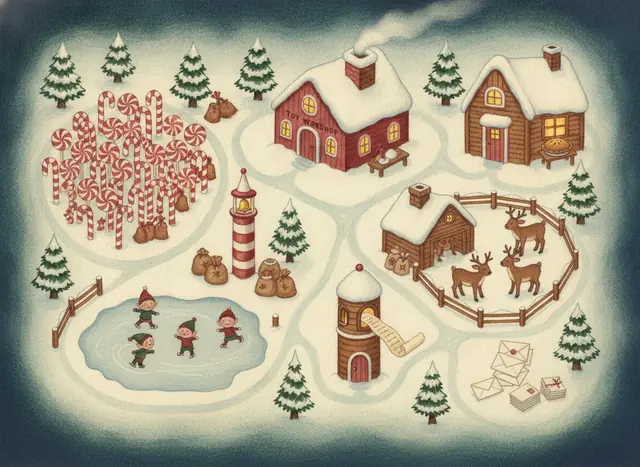
Before 1823 the count was lower. "Old Santeclaus with Much Delight," a little picture book printed in New York in 1821, is the first known story to give Santa a reindeer sleigh. Its sleigh is pulled by just one reindeer, with no name. So the team grew from one in 1821, to eight in 1823, to nine in 1939. In the stories, all nine live in the stable on the North Pole map.

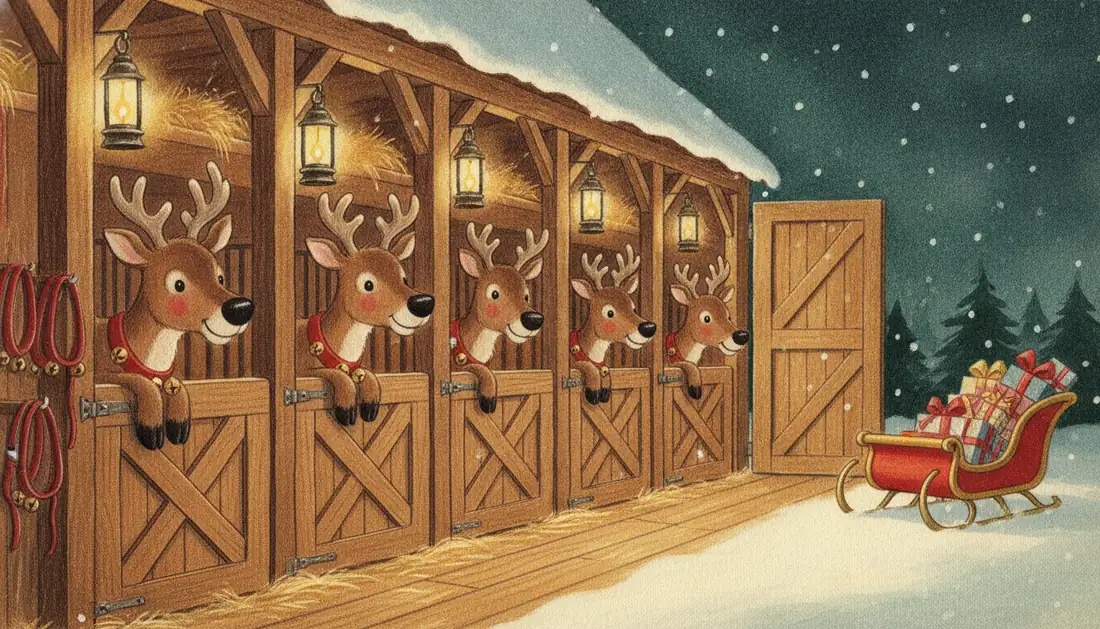
Five smiling reindeer in red collars with gold bells lean over the half doors of a lantern-lit wooden stable, with Santa's red sleigh piled with presents in the snow outside
The reindeer stable, the night before the big flight.

What were the reindeer's original names?

In the first printing of the poem, the last two reindeer were Dunder and Blixem, not Donner and Blitzen. The poem appeared with no author's name in the Troy Sentinel, a newspaper in Troy, New York, on December 23, 1823, under the title "Account of a Visit from St. Nicholas." Dunder and Blixem echo the Dutch words for thunder and lightning, donder and bliksem, which were paired in an old Dutch exclamation. The first six names are the same today as they were in 1823.

The two names that changed, and when.

Reprints kept nudging the spelling. Here is how the seventh and eighth names moved:

YearWhere it was printedReindeer 7 and 8
1823Troy Sentinel, the first printingDunder and Blixem
1825An almanac reprintDunder and Blixen
1837The New-York Book of Poetry, the first to name MooreDonder and Blixen
1844Moore's own book, PoemsDonder and Blitzen
1900sMost books, songs and films sinceDonner and Blitzen

Is it Donner or Donder?

Both are right. Donder is the spelling in Moore's 1844 book and sits close to the Dutch word. Donner is the German word for thunder, and it started to become the usual spelling in the early 1900s. Blitzen leans German too: Blitz means lightning.

The poem first ran under Moore's name in 1837, and he put it in his own book of poems in 1844. Some scholars, including Professor Donald Foster in his 2000 book Author Unknown, argue that Major Henry Livingston Jr. wrote it instead. The question is still open, which is why this page calls it "the 1823 poem." Want more puzzles like this? Try the Christmas trivia quiz.

Where did Rudolph come from?

Rudolph was created in 1939 by Robert L. May, a copywriter for the Montgomery Ward department stores in Chicago. The company wanted a Christmas booklet to give away to children. May wrote a story in verse about a young reindeer teased for his glowing red nose, who saves Christmas Eve when the weather is so bad that Santa can't see to fly. Montgomery Ward handed out about 2.4 million free copies that first year. Before settling on Rudolph, May tried the names Rollo and Reginald.

Ten years later, May's brother-in-law, the songwriter Johnny Marks, turned the story into a song. Gene Autry's 1949 recording went to No. 1 on the US pop chart. Then, on December 6, 1964, NBC aired the stop-motion TV special from the studio later known as Rankin/Bass, narrated by Burl Ives as Sam the Snowman. In that special, Rudolph's father is Donner.

So Rudolph is not in the 1823 poem at all. He joined the team through a store booklet, a song and a TV special, which is why he is counted ninth.

How do Santa's reindeer fly?

The poem never explains it. It only shows them doing it. It compares the team to dry leaves that a wild wind whirls up into the sky, then says, "So up to the house-top the coursers they flew." In other words, they lift off the way leaves swirl up in a storm, and they touch down on the roof. Every story since has filled in the how in its own way.

Stable lore, just for fun

The elves say the reindeer can only fly on Christmas Eve, and only while the sleigh bells are ringing. Ask the reindeer themselves and you get a different answer from each. Dasher says it's the carrots. Comet says it's the starlight. Donner insists it's the cocoa. Vixen won't tell. Mrs. Claus just smiles and keeps baking. Want Santa's answer? Ask him on a live video call.

Leaving food for the reindeer

Many families sprinkle "reindeer food" on the lawn on Christmas Eve. If you do, the RSPB, a UK bird charity, asks families to skip glitter, sequins and cake sprinkles, which can harm wild animals that eat them. It suggests raw porridge oats with sunflower or nyjer seeds instead, plus a few blueberries or bits of apple for color, so the garden birds get a Christmas treat too.

Real reindeer don't fly, but they are champion travelers on foot. Migrating caribou in Alaska can cover up to 50 miles in a single day.

Are reindeer real?

Yes. Reindeer are real, and they are the same animal as the caribou of Alaska and Canada. Wildlife biologists count both as one species, Rangifer tarandus. In North America, "caribou" usually means the wild herds and "reindeer" means the tame, herded kind. In Europe, the wild ones are called reindeer too. Here is what wildlife experts say about the real animals behind Santa's team.

Are Santa's reindeer boys or girls?

If they have antlers on Christmas Eve, most of them are probably girls. Reindeer are the only deer where both males and females grow antlers. The biggest males drop theirs in late fall, after the mating season, around late October and November. Pregnant females keep their antlers all winter, until their calves are born in May or June, and smaller males hold on to theirs until April. So a team of antlered reindeer on December 24 is most likely made of females, with maybe a smaller male or two. The 1823 poem never says, so every family gets to decide for itself.

  • Girls grow antlers too

    Reindeer are the only deer where both sexes grow antlers. A big male's can reach about 51 inches long; a female's about 20 inches.

  • Lichen for dinner

    In winter they scrape away snow with their hooves to eat lichen, often called reindeer moss. In summer it's willow leaves, sedges, flowers and mushrooms: 9 to 18 pounds of plants a day.

  • Fast runners, good swimmers

    Reindeer can sprint at up to about 50 miles per hour and swim at 4 to 6 miles per hour. Hollow outer hairs trap warm air and help them float.

  • Clicking feet

    Many reindeer click as they walk. Zoos say a tendon slipping over a bone in the leg or foot makes the sound. It may help the herd keep track of each other, but nobody knows for sure.

  • Blue eyes for winter

    A layer at the back of an Arctic reindeer's eye turns from gold in summer to deep blue in winter, helping it see in the long Arctic dark. Scientists reported it in 2013.

  • A built-in heater

    Their noses warm icy air before it reaches the lungs, and a keen sense of smell helps them find food buried under snow.

  • How big they get

    In Alaska, adult male caribou average 350 to 400 pounds. Adult females are about half that, 175 to 225 pounds.

  • Spring calves

    In Alaska, caribou calves are born from mid-May to early June. A newborn calf can stand within an hour.

Need a reindeer name of your own?

The quiz above makes one for you. Finish it, type your first name and you get a reindeer name built from your name and your answers, such as Holly Starhoof or Ginger Moondrift. Here are more ideas for a stuffed reindeer, a pet, a class project or a sled:

  • Twinkle
  • Snowdrop
  • Jingles
  • Cocoa
  • Pepper
  • Holly
  • Tinsel
  • Frosty
  • Maple
  • Ginger
  • Clover
  • Juniper
  • Sprinkles
  • Nutmeg
  • Biscuit
  • Aurora
  • Bramble
  • Pinecone
  • Marshmallow
  • Cinnamon
  • Mistletoe
  • Snowflake
  • Sugarplum
  • Velvet

Want a name for the rest of the North Pole crew? Find your elf name next.

Reindeer questions

How many reindeer does Santa have?

Nine, counting Rudolph. The 1823 poem "A Visit from St. Nicholas" names eight, and Rudolph joined in 1939.

What are the names of Santa's reindeer in order?

Dasher, Dancer, Prancer, Vixen, Comet, Cupid, Donner and Blitzen, in the order of the poem, then Rudolph as the ninth.

Which reindeer leads Santa's sleigh?

Rudolph, in most stories since 1939, because his glowing nose lights the way. The 1823 poem doesn't name a leader. It just calls the names in order, starting with Dasher.

Is Rudolph in "'Twas the Night Before Christmas"?

No. That poem is from 1823, and Rudolph was created 116 years later, in 1939, for a Montgomery Ward Christmas booklet.

What does Blitzen mean?

Lightning. Blitz is the German word for lightning. In the first printing of the poem the name was Blixem, close to the Dutch bliksem, which also means lightning.

Are Santa's reindeer boys or girls?

The poem never says. Big male reindeer drop their antlers in late fall, while pregnant females keep theirs until their calves are born in late spring, so an antlered team on Christmas Eve is most likely mostly female.

Can I ask Santa about his reindeer?

Yes. You can talk to Santa on a live video call in your browser and ask which reindeer is fastest or who naps the most. This Santa is an AI video character, so his reindeer stories are for fun. See how to call Santa before you start.

Santa in his red suit on a gold throne, holding a wrapped giftLive video

Ask Santa about his reindeer.

Which one is fastest? Who sneaks extra carrots? Ask him yourself on a live video call, right in your browser. $1 a minute.

Call Santa