Candy cane history: who invented the candy cane?

Nobody knows who invented the candy cane. The popular story of a Cologne choirmaster handing out bent sugar sticks in 1670 is a legend with no record before the mid-1900s. Plain white sugar sticks probably came first, red stripes appear on Christmas cards around 1900, and in 1957 a priest filed a patent for a machine that bends the hooks.

Who invented the candy cane?

Nobody knows, and anyone who names a single inventor is telling a story. The tale you'll hear most goes like this: in 1670, the choirmaster at Cologne Cathedral in Germany handed sugar sticks to the children in his choir to keep them quiet through a long Christmas service, and asked a candy maker to bend them like a shepherd's staff. Snopes went looking for proof and found none. The story was first written down in the mid-1900s, almost 300 years after it was supposed to have happened.

Here is what the records do show. Plain white sugar sticks were a common Christmas sweet. A recipe for peppermint sticks with colored stripes was printed in The Complete Confectioner in 1844. The words "candy cane" appear in an American magazine story in 1866, and a children's magazine tied them to Christmas in 1874. Striped, hooked canes start showing up on Christmas cards around 1900.

Stripe your own candy cane
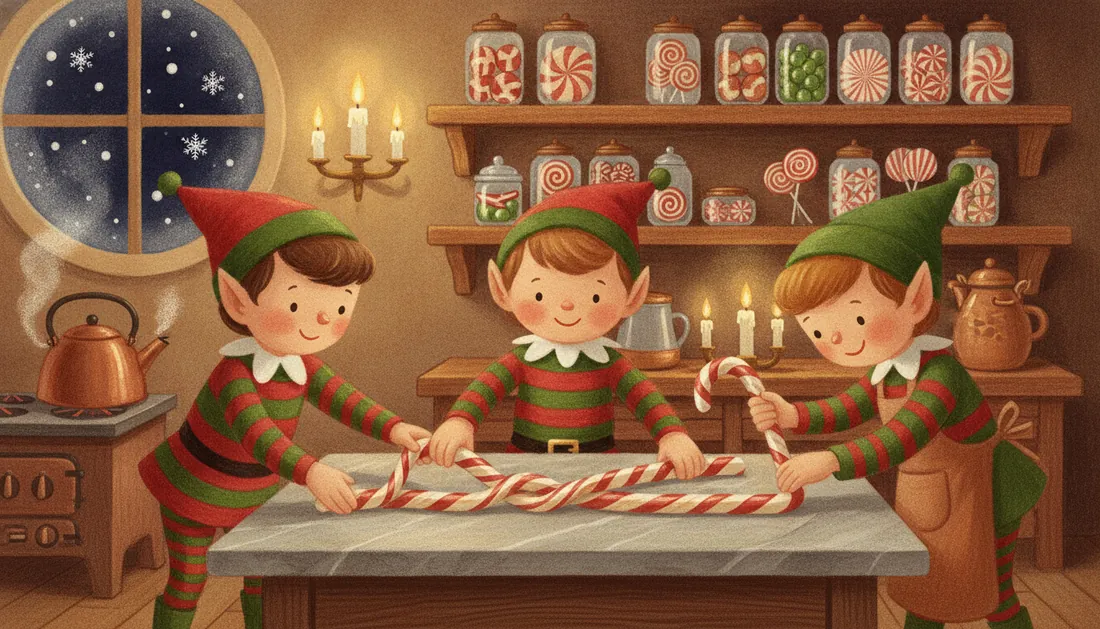
Three elves in striped sweaters twist a long red and white candy cane rope on a marble table in a candy kitchen
In the North Pole candy kitchen, the elves pull and twist a fresh batch by hand.

Candy cane history, year by year

From a legend in Germany to a machine in Georgia, here are the dates you can check, plus the one you can't.

  1. 1670legend

    The legend

    The story goes that a choirmaster at Cologne Cathedral had a candy maker bend sugar sticks into shepherds' crooks for the choir children. No record from that time backs it up.

  2. 1844

    Stripes in print

    The Complete Confectioner explains how to make peppermint candy sticks with colored stripes. They are straight, with no hook.

  3. 1847

    A tree in Ohio

    August Imgard, a German immigrant credited with bringing the Christmas tree to Wooster, Ohio, trims a tree. Many histories say he hung candy canes on it. A 1938 newspaper account of his tree lists paper chains, cookies and gilded nuts instead.

  4. 1866

    The name

    The words "candy cane" appear in print in "Tom Luther's Stockings," a story in Ballou's Monthly Magazine.

  5. 1874

    A Christmas sweet

    The Nursery, a children's magazine, mentions candy canes at Christmas.

  6. About 1900

    Red stripes

    Christmas cards from before 1900 show plain white canes. Red-and-white striped canes start appearing on cards in the early 1900s.

  7. 1919

    Albany, Georgia

    Bob McCormack starts a candy company in Albany, Georgia. By the 1920s it is making candy canes for Christmas. It later becomes Bobs Candies.

  8. 1957

    The bending machine

    Father Gregory Keller, a Catholic priest and McCormack's brother-in-law, files a patent for a candy cane forming machine on May 13. At Bobs, workers had been bending each warm stick by hand.

  9. Late 1950s

    Millions a day

    Workers at Bobs Candies perfect the Keller Machine. By the end of the decade the company makes 1.8 million sticks of candy a day. The patent is granted on October 18, 1960.

  10. December 26

    Candy Cane Day

    National Candy Cane Day in the United States falls the day after Christmas.

Elf-approved flavor Sleigh-Ride Peppermint & Spearmint Swirl Tasted by Elf Juniper: "Extra twisty!"

Stripe your own candy cane

Choose a part, tap a color and set the stripe width. The tasting elves name your flavor, and you can save it as a picture.

1. What are you coloring?
2. Pick a color: Cranberry red

Your cane is drawn on your own device. Nothing is sent anywhere. Want to tell someone about it? On a live video call with Santa, you can tell him your flavor yourself.

How are candy canes made?

A candy cane is hard candy that has been cooked, pulled, striped, twisted and bent. Sugar, corn syrup and water boil to about 300°F (149°C). Candy makers call this the hard crack stage, because syrup dripped into cold water forms brittle threads that snap. The hot candy goes onto a cooling table and peppermint is worked in. Then comes the pulling. Stretching and folding the clear, golden candy traps tiny air bubbles, and it turns silky white. Colored candy is laid along the white log as stripes, and the log is rolled and stretched into a long rope. Twisting the rope turns straight stripes into a spiral. The rope is cut into sticks, and the hook goes in while the candy is still warm. Big factories use machines for nearly every step. At Hammond's Candies in Denver, five or six cooks still shape each hook by hand, about 600 canes in a batch that takes an hour and a half.

  1. Boil

    Sugar, corn syrup and water cook in big kettles to about 300°F. Hammond's Candies in Denver cooks its batches in copper pots at 300 to 325°F.

  2. Cool

    The hot syrup pours onto a steel cooling table. At Hammond's, hot and cold water run through the table, so the candy sets without cooling too fast.

  3. Flavor

    Peppermint goes in while the candy is soft. Factories also knead in a little starch so the candy doesn't get sticky.

  4. Pull

    A pulling machine stretches and folds the candy over and over. Air gets trapped inside, and the clear golden candy turns white.

  5. Stripe

    Strips of colored candy are pressed along a fat log of white candy. Hand makers call the striped outer layer the jacket.

  6. Roll

    A batch roller keeps the log warm and shapes it into a cone. Sizing wheels stretch the cone into a rope as thin as a cane.

  7. Twist and cut

    A twister spins the rope so the straight stripes become a spiral. A cutter snips it into sticks, which are wrapped while still warm.

  8. Crook

    A crooker machine bends the hook. Hand makers grab one end and turn it, judging the curve by eye.

Why are candy canes shaped like a J?

Nobody wrote down why the first cane got its crook, so there are two main ideas. The legend says the Cologne choirmaster had the sticks bent to look like the staffs the shepherds carried in the Christmas story. The plainer idea, which both National Geographic and Snopes mention, is that a hook made the candy easy to hang on a Christmas tree. Neither idea has proof behind it. Early Christmas trees were trimmed with things to eat, like fruit, nuts, cookies and candy, so a sweet with its own hanger made sense.

The hook was also the hard part to make. At Bobs Candies, workers bent each warm stick by hand as it came off the line, and some snapped. Father Keller's machine took over that job in the late 1950s, and production climbed from thousands of canes a day into the millions.

A hook means a candy cane is its own ornament hanger.

Is the J for Jesus? The candy cane meaning story

Many families tell a story that the candy cane was made as a Christian symbol. Turn it upside down and it makes a J for Jesus. The white stands for purity, and the red stripes stand for his suffering. One popular version credits an unnamed candy maker in Indiana.

Snopes rates the claim that candy canes were created as religious symbols False, and Smithsonian magazine reached the same conclusion. No one has found a record of a candy maker designing the cane with that meaning, and the red-striped J does not show up on Christmas cards until around 1900. Snopes lists newspaper columns and picture books from the 1990s that told the meaning as fact. So it is a newer story added to an older candy. It is a lovely one to share at Christmas, as long as everyone knows it is a story.

What colors and flavors do candy canes come in?

Red and white peppermint is still the classic, but stripes now come in nearly every color. Popular Science reported in 2025 that Hammond's Candies in Denver, which still makes its canes by hand, has 26 flavors, including eggnog, root beer, sugar plum, birthday cake and strawberry. The birthday cake cane has five stripe colors plus white. Building its striped jacket takes 25 to 30 minutes, compared with about 15 for peppermint. Novelty shops go stranger. Archie McPhee in Seattle has sold pickle and ketchup candy canes. Most canes are bought in a short rush. The National Confectioners Association says 90 percent sell between Thanksgiving and Christmas, and the biggest week is the second week of December, probably because that is when many families decorate their trees. Counts of how many are made vary. In 2015, National Geographic put it at nearly two billion a year.

  • Peppermint
  • Eggnog
  • Root beer
  • Sugar plum
  • Birthday cake
  • Strawberry
  • Pickle
  • Ketchup

A rack of the flavors on this page, striped by the North Pole elves.

Why do candy canes taste cold?

Peppermint is full of menthol. Menthol switches on a sensor in the nerves of your mouth called TRPM8, the same sensor that reacts to real cold. Your brain gets a "cold!" message even though nothing in your mouth changed temperature. Peppermint has a long history in sweets: in the 1700s, apothecaries mixed it into sugar to cover the taste of bitter medicine, and the 1844 striped-stick recipe was already peppermint.

Think you'll remember all this on Christmas morning? Try the Christmas trivia quiz, or borrow a groaner from the Christmas jokes for the dinner table.

Lollipop history: who invented the lollipop?

Candy on a stick has probably been invented many times, so no one can name the first lollipop maker. The word is old: British dictionaries of the early 1800s already defined a lollipop as a hard sweet, sometimes on a stick. The American lollipop is usually traced to George Smith of the Bradley Smith Company in New Haven, Connecticut, which began selling hard candy on sticks in 1908. The story goes that Smith named it after a racehorse called Lolly Pop.

When the company asked for a trademark, the Patent Office pointed to those old dictionaries and said no. So it applied again with the name split in two, and on October 13, 1931, "Lolly Pop" became a registered trademark. Other candy makers used "lollipop" so much that the two spellings soon blurred together. Candy canes and lollipops are close cousins. At Hammond's, the recipe is almost the same: one cook rolls the candy into a circle while another adds the stick, and a batch makes about 1,000 lollipops instead of 600 canes.

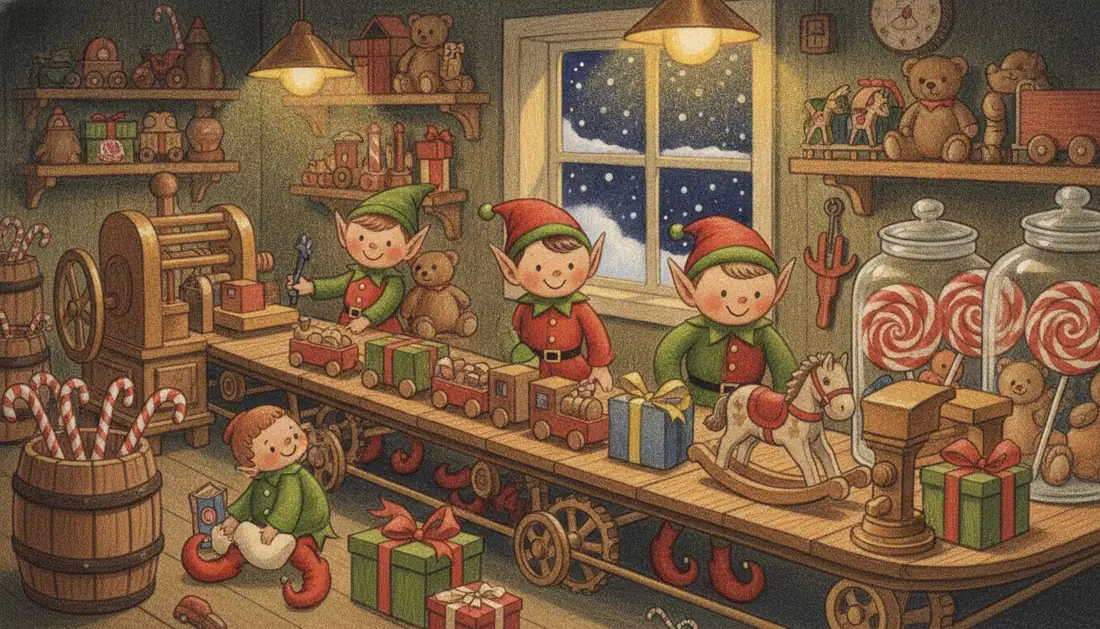
Elves build toys on a wooden conveyor belt beside a barrel of candy canes and tall glass jars of swirl lollipops
Candy canes in the barrel, swirl lollipops in the jars.

Make a candy cane at home, no hot sugar needed

Real candy canes need syrup at 300°F that gets pulled while it is hot, so they are a job for grown-ups with heat-proof gloves. These two are safe for the whole family. The ornament uses the stripe pattern you made above. The bark uses store-bought candy canes, and the kids get the best job: smashing them.

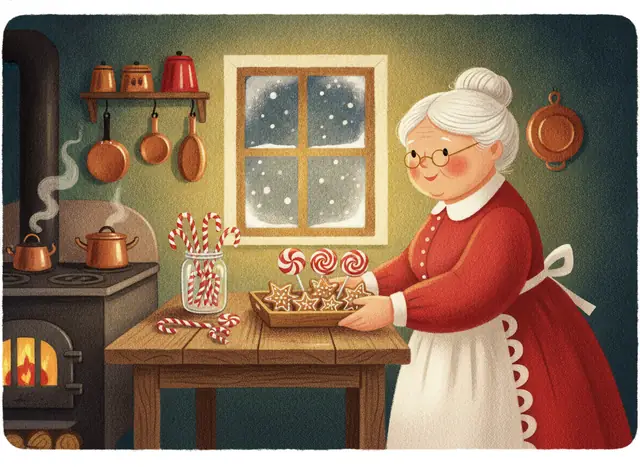
Mrs. Claus keeps a jar of candy canes by her stove all winter. Peek into her kitchen on the Mrs. Claus page, or wander the rest of the North Pole.

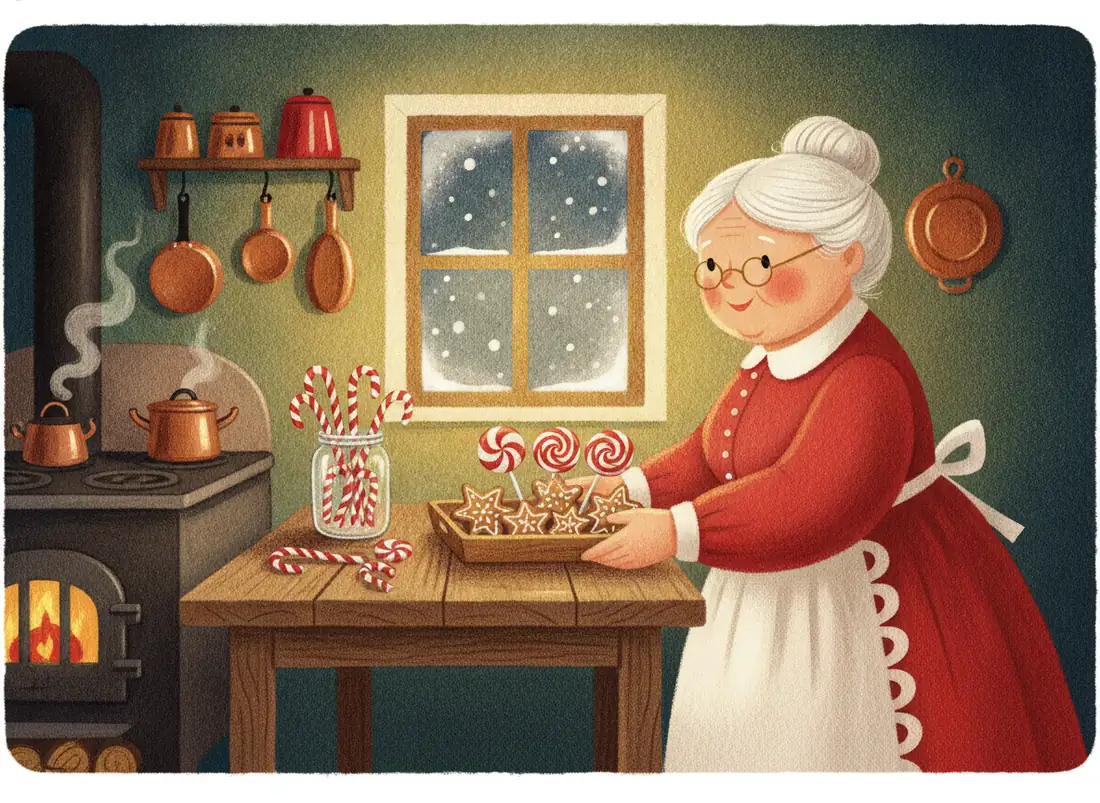
Mrs. Claus carries a tray of gingerbread stars and swirl lollipops past a jar of candy canes in her warm kitchen
Mrs. Claus's kitchen, with the candy cane jar on the table.

Beaded candy cane ornament

Kids 3 and up with a grown-up nearby · about 10 minutes

You need

  • 1 pipe cleaner, 12 inches (30 cm) long
  • 30 to 40 pony beads in 2 or 3 colors
  • 8 inches (20 cm) of ribbon for hanging, if you like

Steps

  1. Bend a tiny loop at one end of the pipe cleaner so the beads can't slide off.
  2. Pick a pattern. Copy the cane you striped above, for example 3 white, 2 red, 1 green, and repeat.
  3. Thread beads until about 1 inch (2.5 cm) of pipe cleaner is left. Bend a tiny loop at that end too.
  4. Wrap the top third around a thick marker to make the hook, then slide the marker out.
  5. Hang it on the tree, or tie on the ribbon and use it as a gift tag.

Beads are a choking hazard. Keep them away from babies and toddlers under 3.
Peppermint bark

With a grown-up · one 8 x 8 inch pan · 15 minutes plus about 1 hour 10 minutes in the fridge

You need

  • 8 oz (225 g) semisweet chocolate, chopped
  • 8 oz (225 g) white chocolate, chopped
  • 1 teaspoon cooking oil, split into two 1/2 teaspoons
  • 1/2 teaspoon peppermint extract, split into two 1/4 teaspoons
  • 5 regular candy canes

Steps

  1. Line an 8 x 8 inch (20 cm) pan with parchment paper.
  2. Kids: unwrap the candy canes, put them in a zip-top bag, seal it and crush them with a rolling pin.
  3. Grown-ups: put the semisweet chocolate and 1/2 teaspoon oil in a bowl. Melt it in the microwave, stirring every 20 to 30 seconds, until smooth. Stir in 1/4 teaspoon extract and spread it in the pan.
  4. Chill 10 to 12 minutes, until mostly set but not hard, so the next layer sticks.
  5. Melt the white chocolate with the other 1/2 teaspoon oil the same way. It overheats easily, so go slowly. Stir in the other 1/4 teaspoon extract and spread it over the dark layer.
  6. Sprinkle the crushed candy canes on top.
  7. Chill about 1 hour, until fully set, then break into pieces. Keep leftovers covered in the fridge for 2 to 3 weeks.

Bowls get hot in the microwave. Grown-ups do the melting and spreading.

Candy cane questions

Who invented the candy cane?

No one knows. The 1670 Cologne Cathedral story is a legend with no record before the mid-1900s. The person with the strongest real claim to fame is Father Gregory Keller, and he invented the machine that bends the hook, not the candy.

When did candy canes get red stripes?

Striped peppermint sticks were described in a cookbook in 1844, but Christmas cards from before 1900 show plain white canes. Red-and-white canes appear on cards in the early 1900s.

Who invented the candy cane bending machine?

Father Gregory Keller, a Catholic priest and Bob McCormack's brother-in-law, filed a patent for a candy cane forming machine on May 13, 1957. It was granted on October 18, 1960, and Bobs Candies of Albany, Georgia used it to bend canes by the million.

When is National Candy Cane Day?

December 26, the day after Christmas, in the United States.

Can you make real candy canes at home?

You can, but the syrup reaches about 300°F and has to be pulled and twisted while hot, so it is a grown-up job with heat-proof gloves. With kids, try the bead ornament or peppermint bark instead.

Can I ask Santa about candy canes?

Yes. Here is how to call Santa on a live video call. Ask him which flavor he likes best, then tell him what you're wishing for this year.

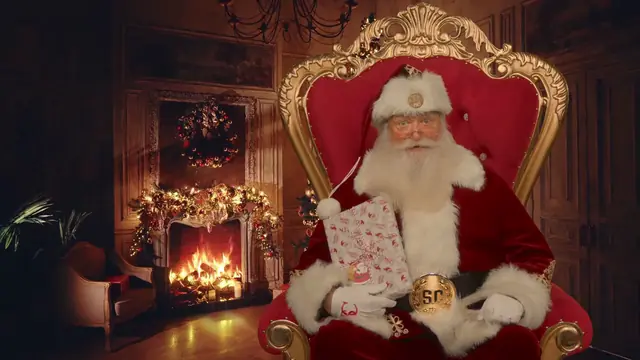
Santa in his red suit on a gold throne, holding a wrapped giftLive video

Tell Santa your flavor.

On a live video call, Santa listens and answers out loud. Tell him your elf-approved flavor, then tell him what you'd like for Christmas. $1 a minute.

Call Santa